
How MESD Technology Built an AI-Powered Multilingual News Publishing Engine
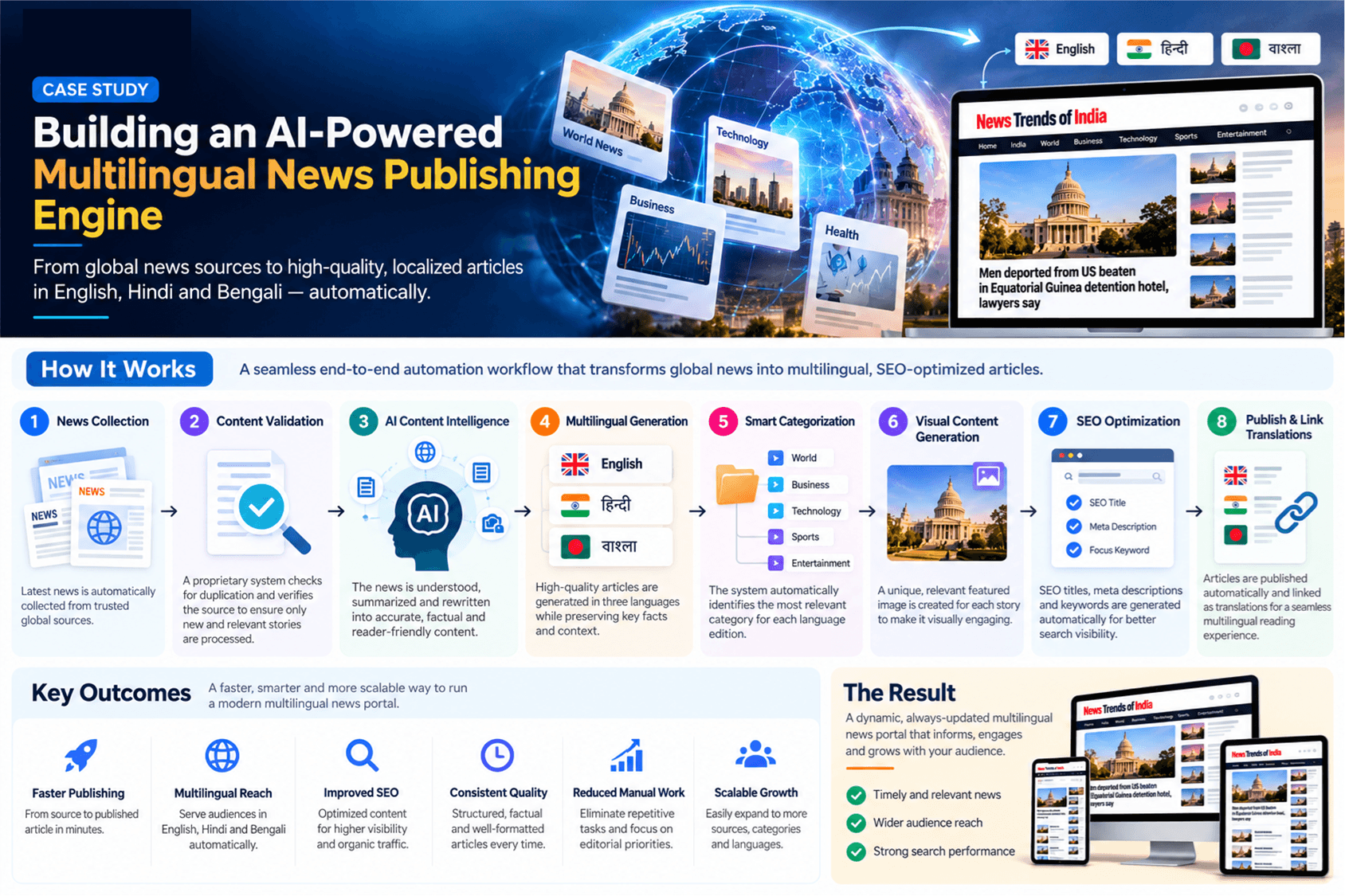
From One News Story to Three Complete Language Editions
Digital news publishing looks simple from the outside. A story appears, someone writes an article, and the article gets published.
Behind the scenes, however, every story involves a chain of activities: identifying relevant information, checking whether the story has already been covered, understanding the source, preparing the article, selecting the right editorial category, creating language versions, optimizing metadata for search, preparing a visual, assigning publishing attributes and finally making the story available to readers.
For a multilingual publication, that operational burden grows substantially.
At MESD Technology, we explored a larger question:
Could artificial intelligence participate in the complete publishing process rather than simply generating text?
That question led to the development of an AI-powered multilingual news publishing engine capable of transforming a structured news input into coordinated English, Hindi and Bengali news editions while also managing the operational tasks surrounding digital publication.
The system has been successfully designed, implemented and tested as a functioning automation environment.
The Challenge Was Never Just Writing
Generative AI can already produce paragraphs, summaries and translations. But writing an article is only one part of running a digital publication.
A newsroom must continuously coordinate information intake, duplication control, editorial classification, language handling, visual assets, search optimization and publishing.
When these tasks are performed manually, each additional article requires additional editorial effort. Add multiple languages and the number of repetitive operations increases again.
The engineering challenge for MESD Technology was therefore not:
“Can AI write a news story?”
It was:
“Can an intelligent system coordinate the complete journey from incoming information to a structured, multilingual and publication-ready digital article?”
That distinction became the foundation of the project.
The Vision: AI as Publishing Infrastructure
Rather than treating AI as a standalone content writer, MESD Technology designed the solution as a series of connected intelligence layers.
At a high level, the system follows this architecture:
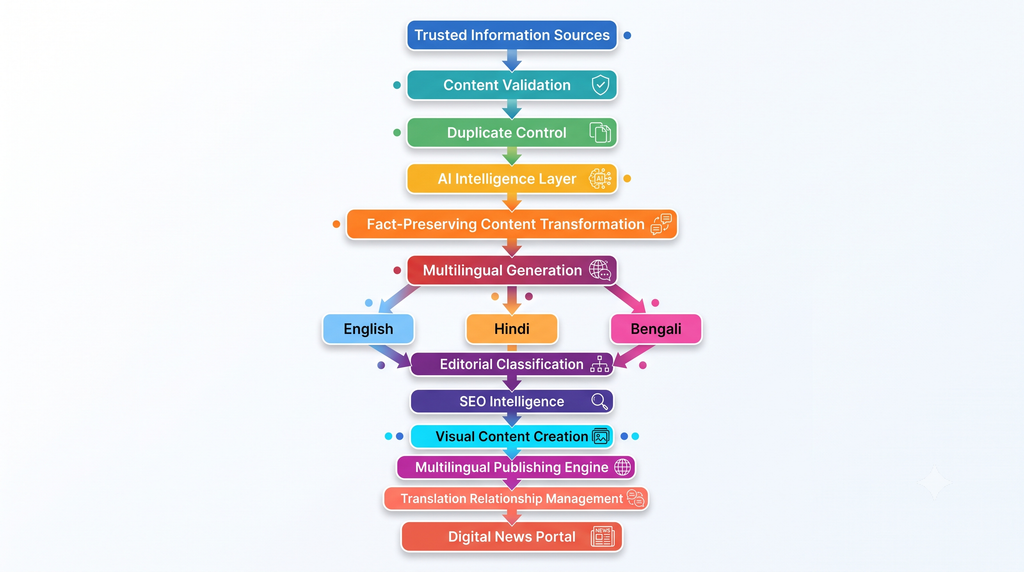
The specific orchestration logic, integrations, validation mechanisms and implementation architecture remain proprietary to MESD Technology.
How the Intelligent Publishing Engine Works
Automated Content Intake
The process begins by receiving structured information from selected digital news sources.
The objective is not simply to collect as much information as possible. The publishing engine is designed to feed relevant stories into a controlled processing pipeline where each item can be assessed independently.
The system can regulate how many stories are handled during a processing cycle and can process items sequentially when required. This becomes important when operating at scale because uncontrolled simultaneous publishing operations can place unnecessary pressure on the surrounding infrastructure.
Duplicate Detection Before AI Processing
One of the earliest safeguards is duplicate detection.
Before computational resources are spent generating content, the system checks whether the underlying story has already passed through the publishing environment.
The logic is straightforward:
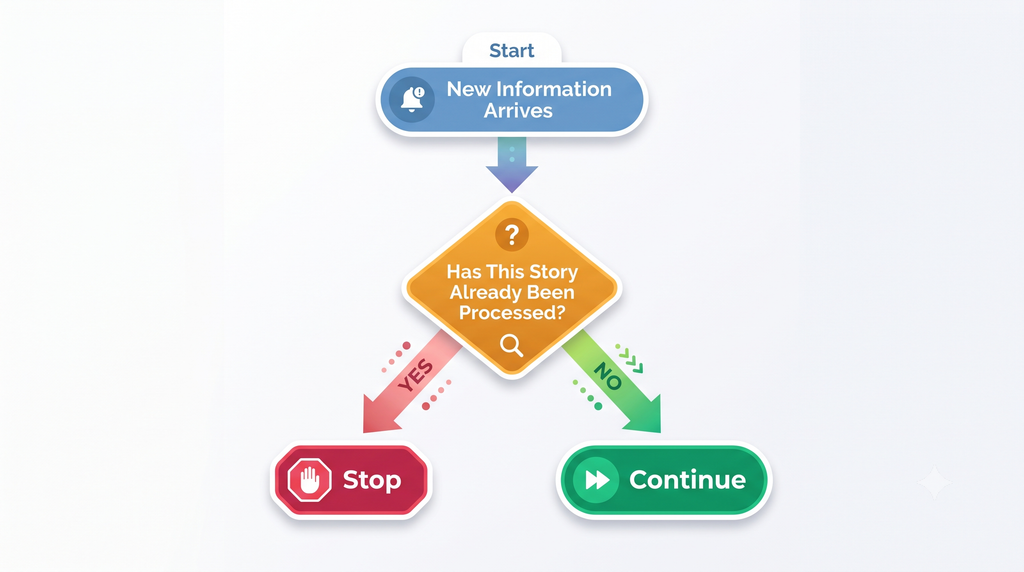
This layer becomes essential when a publishing system operates continuously.
Without duplicate protection, automated workflows can repeatedly recreate the same article whenever a source feed is checked again.
By validating the source before generation begins, unnecessary processing and duplicate publication risk can be substantially reduced.
AI-Based Understanding Before Generation
The intelligence layer does not immediately rewrite whatever text it receives.
It first needs to understand the information.
The system is designed to identify important components such as people, organizations, locations, events, dates, numerical information, contextual relationships and attributed claims.
For news-related content, attribution is particularly important.
If a source reports an allegation, the generated article should retain the fact that it is an allegation rather than silently transforming it into an established fact.
This type of distinction separates useful publishing automation from uncontrolled text generation.
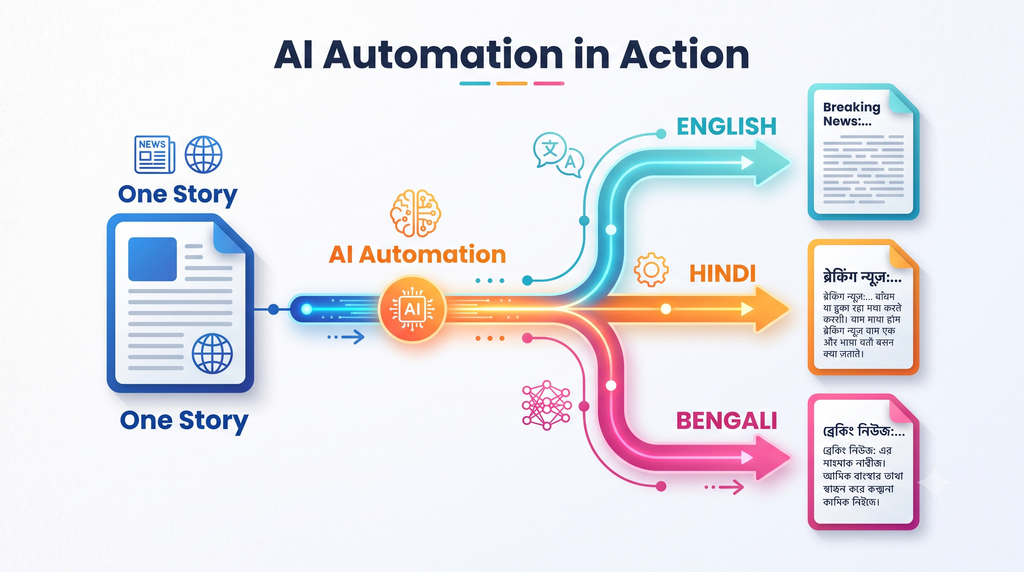
One Story, Three Language Editions
Once the story has been interpreted, the system prepares coordinated editions in:
English, Hindi and Bengali.
Each version is treated as an independent article rather than merely as a copy of the English article with words replaced.
The system can generate language-specific headlines, excerpts, body content, URLs, search metadata and descriptive information while preserving the factual relationship between the three editions.
The objective is localization rather than literal translation.
A Hindi reader should receive a Hindi news article. A Bengali reader should receive a Bengali news article. Neither version should feel like a mechanically translated English document.
Structured AI Output Makes Automation Possible
One of the most important architectural decisions was to avoid relying on uncontrolled blocks of generated text.
Instead, information is returned in a structured format.
The publishing environment can therefore distinguish between elements such as the article title, excerpt, body, editorial category, SEO title, meta description, focus keyword, source reference and visual brief.
This makes AI output machine-actionable.
Without structured output, another system would have to guess which part of the response represented a title, which represented metadata and which represented the body.
With structured generation, downstream processes can use the information directly.
This principle is applicable far beyond publishing.
For business automation, structured AI output is often more valuable than conversational AI output.
Intelligent Editorial Classification
A publishing portal usually contains several content sections.
A story may belong to World News, Business, Technology, Education, Sports, Entertainment, Science or another editorial domain.
The engine automatically determines the relevant editorial classification and then associates each language edition with the appropriate corresponding publishing category.
This removes another repetitive administrative step from the workflow.
The intelligence layer identifies what the article is about; the publishing layer determines where that article belongs.
Language-Aware Publishing
Creating Hindi text does not automatically make an article a Hindi article from the perspective of a multilingual publishing system.
The publishing environment must explicitly understand which language belongs to each item.
The system therefore carries language information throughout the publishing process so that the final environment understands:
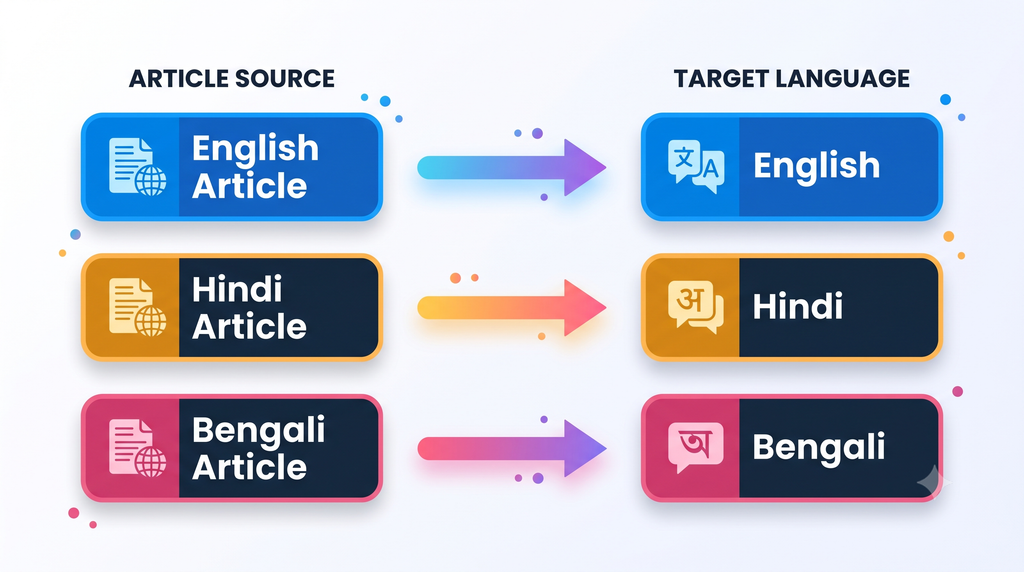
This information can then be consumed by both the content-management environment and a modern frontend application.
It enables language-specific navigation, filtering, indexing and presentation.
Connecting the Three Editions as One Story
A more complex challenge appears after the three articles have been created.
They must not remain three unrelated posts.
They are different editions of one underlying story.
The publishing engine therefore creates a logical relationship between them:
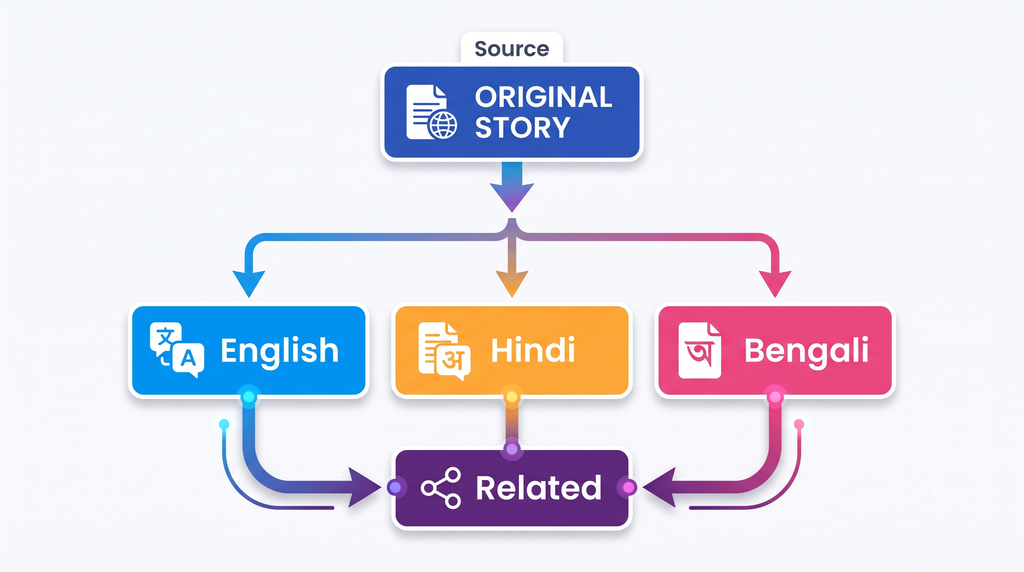
This relationship enables the reader to switch languages while remaining on the same story.
It also gives a headless or API-driven website a clean way to identify the corresponding language versions.
The frontend does not need to guess whether two similar headlines refer to the same event. The relationship is already available as structured publishing data.
Visual Content Is Part of the Workflow
Text alone is not enough for a modern digital news experience.
The system can produce a visual brief based on the article and create an appropriate editorial-style featured image.
Rather than unnecessarily generating the same concept three times, a single visual asset can be shared across the related editions.
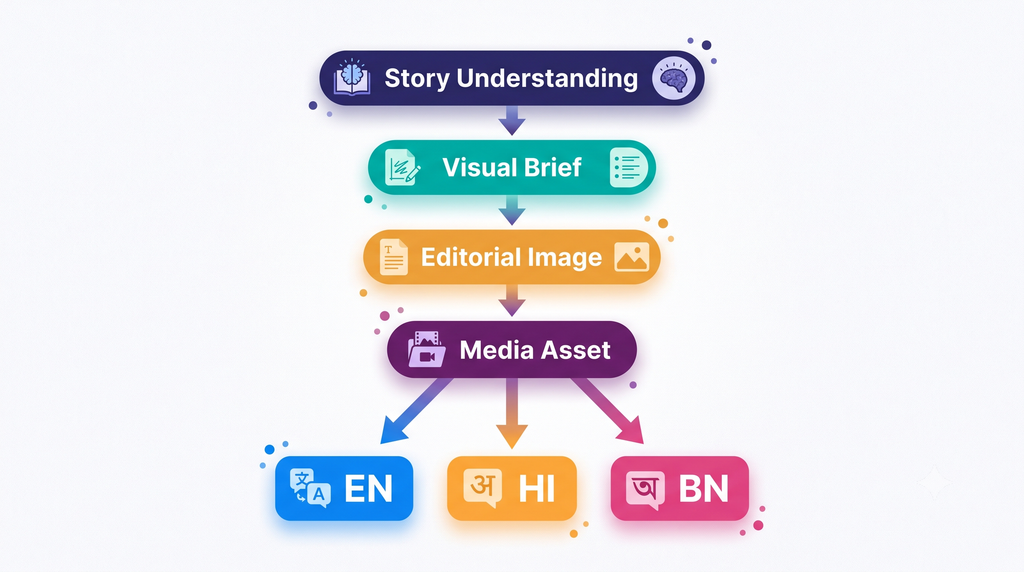
This approach improves visual consistency and reduces duplicate media storage.
The visual layer can also be governed by safeguards intended to avoid creating misleading documentary evidence for events that were not actually photographed by the system.
For news automation, that distinction matters.
Search Optimization Is Generated with the Article
Search visibility is another task that normally happens after an article has been written.
MESD Technology’s publishing architecture treats SEO as part of the content-generation process itself.
Each language edition can receive its own search-oriented metadata, including an optimized title, meta description, focus keyword, URL structure and excerpt.
This matters because multilingual publishing should not mean applying English SEO metadata to every language.
Search intent, wording and natural phrasing vary between languages.
A properly designed multilingual publishing system needs to respect that difference.
Draft First, Publish Last
Another important design choice was to separate content creation from final publication.
The system does not need to expose an article immediately after the initial draft is created.
Instead, the article can pass through its required operational stages first.
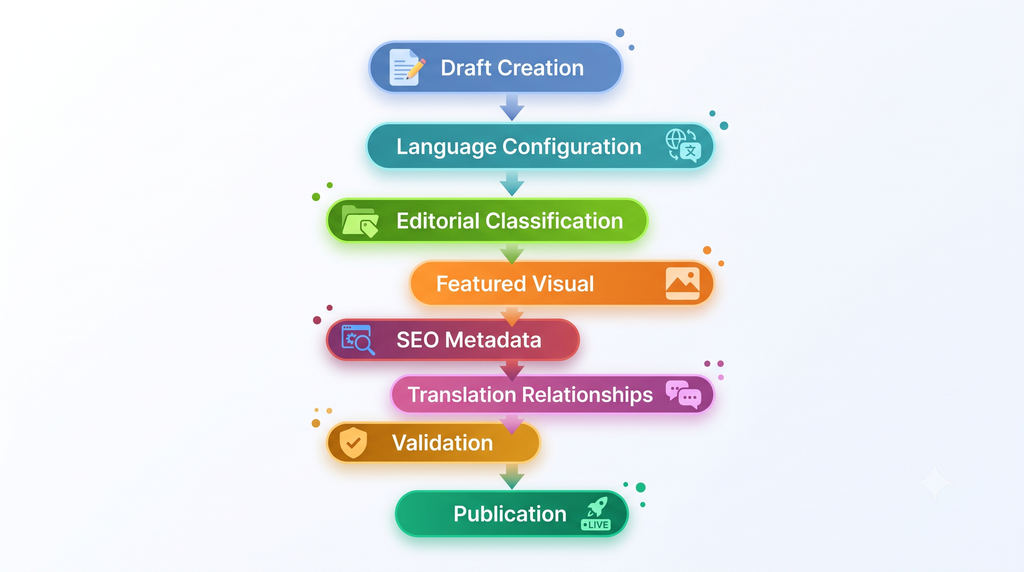
This creates a much safer operational model.
A partially processed article should not appear publicly simply because the first stage of automation succeeded.
Publication becomes the final action after the required components are in place.
Why This Is More Than AI Content Generation
There is an important difference between generating text and operating a publishing system.
An AI writing tool might produce an article.
An intelligent publishing engine must coordinate the relationship between the article and everything surrounding it.
That includes the source, language, classification, visual asset, metadata, related translations, duplicate state and publication status.
The real system therefore looks more like this:
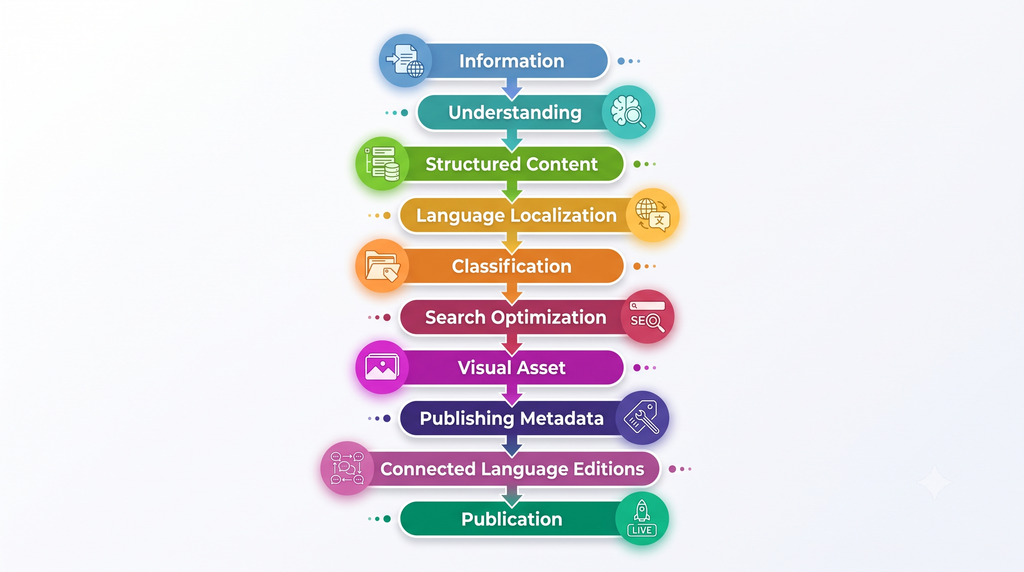
That orchestration is where AI begins to become infrastructure rather than simply a writing assistant.
Business Impact
The project demonstrates how intelligent automation could materially change digital publishing operations.
Faster publishing cycles can reduce the time between receiving information and preparing a publication-ready story. Multilingual reach allows the same editorial operation to serve audiences across different languages without building completely separate workflows. SEO consistency means search metadata can become part of the standard publishing process rather than an optional activity performed later.
The system can also reduce repetitive administrative work such as copying content between systems, manually assigning attributes and repeatedly configuring related editions. This allows human teams to spend more time on editorial judgment, reporting, investigation and higher-value content decisions.
Most importantly, the architecture is designed to scale. Increasing publishing volume does not necessarily require every operational step to increase at the same rate.
Where Human Editorial Responsibility Remains Essential
Automation should not be confused with editorial accountability.
Journalism and professional publishing still require human responsibility for source verification, legal risk, public-interest judgment, corrections, investigative work, sensitive-topic handling and final editorial standards.
For this reason, the long-term model is not:
AI replacing journalists
It is:
AI automation supporting editorial teams
AI is particularly valuable for structured and repetitive operations.
Humans remain essential where contextual understanding, responsibility and judgment are required.
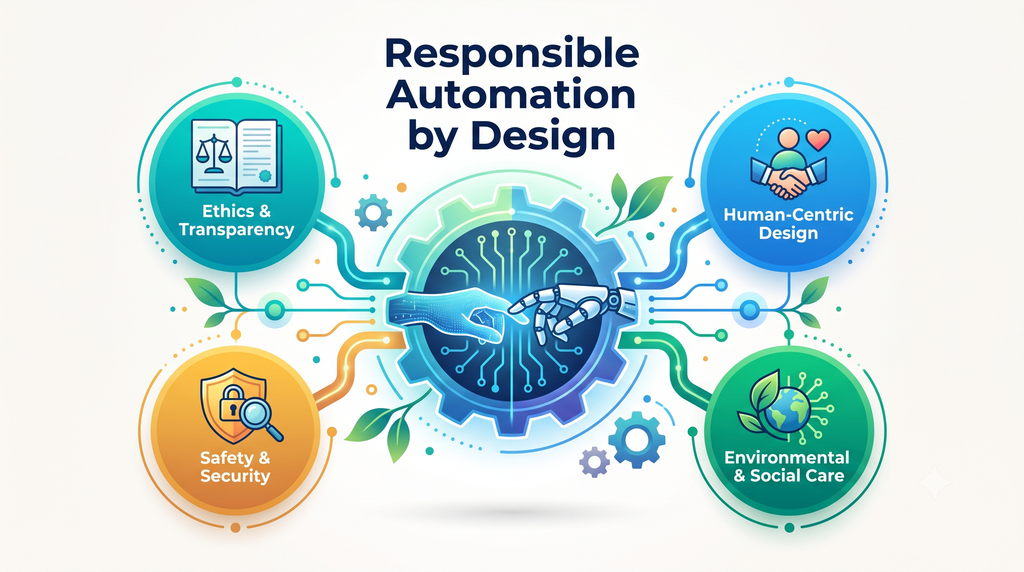
Responsible Automation by Design
A scalable AI publishing system requires safeguards.
MESD Technology’s approach is built around controlled processing rather than unrestricted generation.
Important principles include source traceability, duplicate prevention, structured outputs, factual consistency, language validation, controlled publication states and the ability to include human review where appropriate.
As the platform evolves, additional intelligence layers could include source-confidence scoring, automated cross-source verification, sensitive-topic detection, editorial approval queues, misinformation-risk indicators and image validation.
The more capable an automated publishing system becomes, the more important governance becomes alongside it.
The Opportunity Extends Beyond News
Although this project was designed around digital news publishing, the underlying architecture can apply to many other content-intensive environments.
An education portal could convert institutional updates into multilingual student information. A corporate platform could automatically prepare announcements for different regions. A research organization could turn technical information into structured public communication. Government and public-information systems could use similar architectures for multilingual citizen communication.
Travel, finance, healthcare information, industry publications and knowledge-management systems also contain workflows where the same underlying pattern appears:
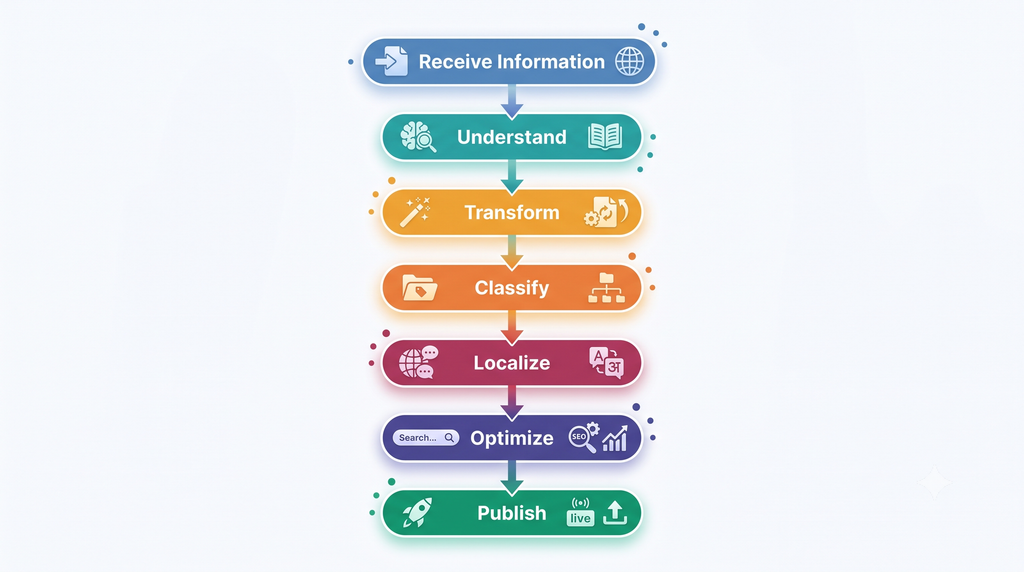
The value lies not in one specific publishing use case.
It lies in the reusable automation architecture.
From Generative AI to Intelligent Operations
The first phase of enterprise Generative AI adoption was dominated by questions such as:
“Can AI write an email?”
“Can AI summarize this document?”
“Can AI generate a blog?”
Those capabilities remain useful, but they represent only a small part of the opportunity.
The more important question for organizations is increasingly:
“Can AI become part of the process through which work is completed?”
That requires more than prompting.
It requires architecture.
AI needs to interact with business rules, validation logic, structured data, digital systems, publishing platforms and operational safeguards.
This case study demonstrates that transition.
The AI is not merely producing content.
It is participating in a complete publishing operation.
What Comes Next?
The current publishing architecture creates a foundation for significantly more advanced capabilities.
Future development could incorporate continuous source monitoring, automated story prioritization, breaking-news detection, cross-source factual validation, related-story discovery, intelligent internal linking, audience-based personalization, editorial analytics, social publishing, regional targeting and additional Indian languages.
It could also evolve toward intelligent editorial dashboards where AI assists teams in identifying which stories deserve attention rather than automatically processing every available story.
That is where automation becomes not only faster, but smarter.
Conclusion
MESD Technology has successfully designed and tested an AI-powered multilingual news publishing engine capable of coordinating a substantial portion of the digital publishing lifecycle.
Starting from a structured source story, the system can support content validation, duplication control, AI interpretation, multilingual article generation, editorial categorization, visual creation, SEO preparation, language configuration, translation relationships and publication readiness.
The technical implementation remains proprietary.
The result, however, demonstrates something larger:
The real potential of Generative AI is not just generating content. It is redesigning complete business processes around intelligence and automation.
For publishers and other content-intensive organizations, this represents an important shift from using AI as a productivity tool to using AI as part of the organization’s digital infrastructure.
Transform Your Content Operations with AI
Organizations across industries still depend heavily on repetitive digital processes involving content, documents, data, approvals, communication, reporting and publishing.
MESD Technology helps businesses explore how these workflows can be transformed using Artificial Intelligence, Intelligent Automation, AI Agents and Custom Digital Solutions.
MESD Technology
www.mesdtech.com
From repetitive digital work to intelligent, scalable operations.
Talk to MESD Technology about your AI automation use case.